


The Village of Slinger has been a member of Tree City USA for 14 years.

The Village of Slinger became a member of Bird City Wisconsin as of January 2026.
Trees maintained by the Village are those between the sidewalk and curb or in the Village street right of ways and parks. The Village will remove and replace dead or dying trees free of charge. Planning and planting new street trees throughout the Village is also a major role of the department. Owners are responsible for removal of trees on their property.
Things to Consider Before Planting a Tree
- Where to Plant
- If there are overhead utilities, plant a low growing tree or select a different planting site. Planting a tall growing tree where it doesn’t have room to grow can lead to the unsightly and unhealthy practice of topping.
- Right Tree, Right Place
- Make sure you leave plenty of room for your tree to grow. That perfect spot right next to your house may not be so perfect when the tree reaches its mature size.
- The Hardiness Zone
- Know your hardiness zone and choose trees adapted to that zone.
7 Steps in Planting Your Tree
Important – Call Before You Dig! Contact Diggers Hotline at 1-800-242-8511
- Determine where the root collar is located within the root ball.
- Dig a planting space two to three times wider than the root ball, but no deeper. To determine propert planting depth, measure the distance from the bottom of the root ball to the root collar.
- Before placing a tree in its planting space, remove all tags, ribbons, and trunk guard. To avoid root damage, don’t drag or lift the tree by the trunk. Gently guide the tree into the planting hole.
- Remove twine, clip and fold back wire basket and trim burlap. If left on, this material can girdle the tree. Note: If planting a containerized tree remove the entire pot.
- Carefully remove soil from the top of the root ball to expose the root collar. Check to see that the root collar is either level with or 1″ to 2″ above finished grade. Planting a tree too deep can kill it!
- Back fill planting space with soil. Water thoroughly to eliminate air pockets. Do not tamp!
- Celebrate a job well done…a properly planted tree!
Caring for Your Tree
- Watering
- Water as needed throughout the season, about 1″ per week.
- Mulching
- To properly mulch, apply 2″ to 4″ of woody mulch (aged wood chips, shredded bark or something similar) over the root zone. Make sure to pull the mulch 3″ to 6″ away from the trunk.
- Staking
- Most newly planted trees do not need to be staked. If staking is necessary, use wide webbing straps. Secure webbing to stakes with heavy gauge wire. Attach materials so that the tree is allowed to move in the wind. Do not encircle the tree with wire threaded through a garden hose – this can girdle the tree.
- Proper Pruning
- Less is better, newly planted trees need all the leaves they can get. Remove only dead, broken, diseased or rubbing branches.
The Wisconsin Department of Natural Resources.
Why, When and How Much to Prune?
- Why Prune?
- For future health – Prune a tree to establish good branch structure and spacing, and once central trunk.
- For safety – Pruning assures that the vision or sight lines of motorists, bikers or pedestrians are not compromised. Prune limbs to reduce conflicts with traffic signs, utilities or to prevent potential hazards.
- For aesthetics – A well maintained tree looks good and adds value to your property.
- When to Prune?
- Prune when the tree is dormany, typically November through March in Wisconsin. The worst time to prune a tree is in the spring when tree buds and leaves are growing.
- How much to Prune?
- Avoid removing more than 25% of the live branches from a tree, no matter what the tree’s age, size or species.
What to do
- Before pruning take a step back and look at your tree.
- Envision your tree after it’s pruned. Remember you can always take more off, but can’t put it back on.
- Always have a purpose in mind before a cut is made.
What Not to Do
- Avoid leaving too much or too little of the pruned branch.
- Stub Cut (leaving too much) – Finish cuts should never leave a stub that a cap can hang from.
- Flush Cut (leaving too little) – A flush cut opens the tree to decay and prevents proper and complete wound closure.
- Never top your tree. Don’t make the mistake of cutting off the top of a tree’s canopy to reduce its size. Besides being unattractive, topping leads to weak growth and decay.
How to Prune
- Tools to Use
- Tools should be sharp so as not to crush limbs. Loppers and hand pruners should be of the bypass or scissors type. Saw blades should have triple-edged teeth. A hard hat, leather gloves and eye protection are recommended. Before using a pole saw, always check for overhead utilities.
- Pole saw & lopper head
- Hand saws
- Helmet & safety glasses
- Hand pruner
- Leather gloves
- Long-handled lopper
- Tools should be sharp so as not to crush limbs. Loppers and hand pruners should be of the bypass or scissors type. Saw blades should have triple-edged teeth. A hard hat, leather gloves and eye protection are recommended. Before using a pole saw, always check for overhead utilities.
3 Steps to Pruning
- At least 12 – 18″ from the final vut, make an undercut approximately 1/3 of the way through the branch.
- Outside the first cut, sawing from the top down, completely remove the branch.
- Begin the final cut outside of the branch bark ridge, continuing at a slightly outward angle, finishing the cut just outside the branch collar. It is not necessary nor recommended to paint the wound.
Wisconsin Department of Natural Resources
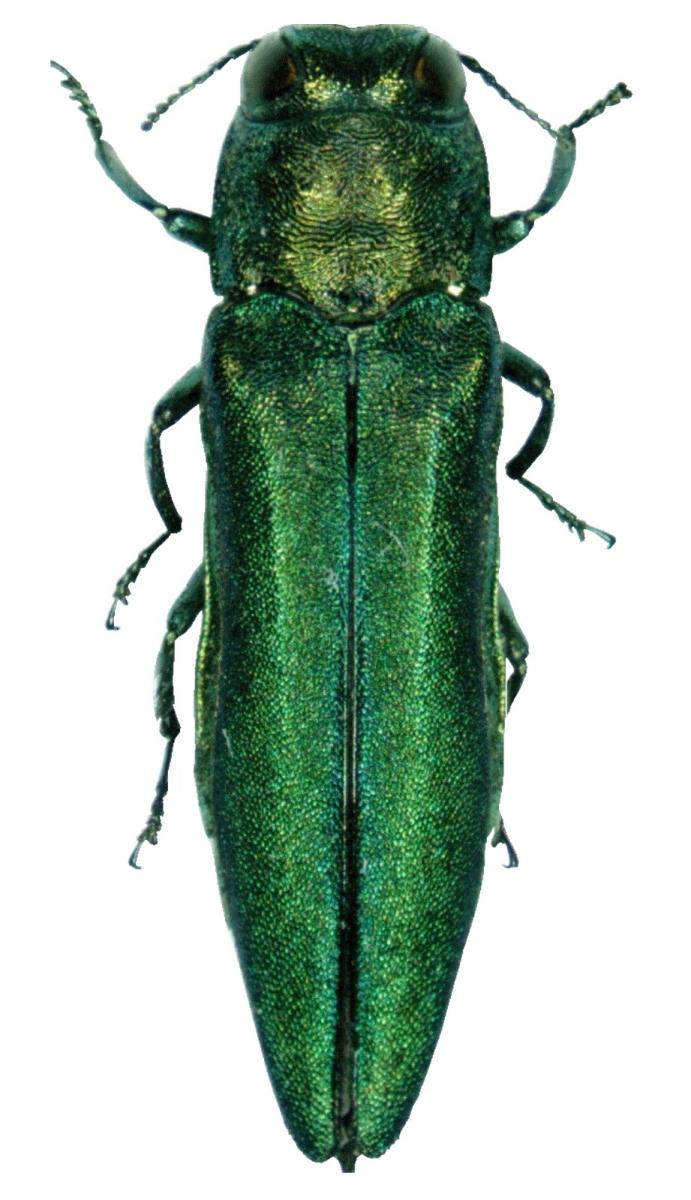
A close-up picture of an Emerald Ash Borer.
The emerald ash borer is an invasive insect native to Asia that was introduced into the United States via wooden packing material. It was discovered in Detroit, MI in 2002. The insect has spread throughout the Midwest since its arrival adnw as first discovered in Wisconsin in 2008. In Asia, the insect has little impact due to the existence of natural insect predators; however, in the United States there are no natural predators to keep the insect in check and therefore has had a devastating effect on our native ash tree population. An ash tree, once infested with EAB, will eventuall die.
Why does the Village Plan on Cutting Public Ash Along Streets in Advance of EAB?
In August 2007, Wisconsin Department of Natural Resources urban foresters toured cities in Michigan and Ohio hit hard by EAB. Standard advice they hard from their counterparts in those states was to avoid getting caught in “catch-up mode.” EAB often is not found until it has been present for a couple years or more. Larvae multiply unnoticed in the upper reaches of ashes. Communities began noticing problems only after EAB had spread downward and ashes started dying in batches. Their maintenance crews could not keep pace. Standing dead ash became liability concerns and eyesores for residents. Westland, Michigan crews reached a point where they had to resort to cutting trunks at 12 feet above ground and leaving them. That city had to put off pruning and other routine tree work for five years. In every Village and City they visted, DNR foresters heard about problems that could be avoided or minimized through “preemptive removal.”
Some advantages of removing ash before EAB arrives:
- Standing, EAB-infested trees will pose liability problems for the village. Dead ash wood is extra brittle and large branches on dying trees become susceptible to snapping in storms.
- Removing an ash that is dying or dead costs significantly more than removing a live one for two reasons: (a) dead ash wood is unpredictable and arborists must take added precautions and time and (b) unlike a live ash, a dead one shatters when it hits the ground, shooting debris, requiring extensive clean-up work.
- Brittle, dead ash branches and trunks are much harder on chain saws and wood chippers than are live ones. Increased equipment maintenance and delays are more likely.
- EAB-infested trees, once upper branches begin to die and crowns lose foliage, blemish street and park landscape views.
- Gradual, preemptive removal avoids organizational problems that could interrupt Village services and additionally strain local funds.
- Waiting to remove ash prolongs the time it takes a replacement tree to reach the size where it begins providing measureable shade, reduce energy bills, increase property values, abate storm water runoff, improve air quality, and add other economic and environmental benefits.
The Parks, Public Works & Forestry Department provides curbside pickup of brush between April and November. Larger branches, with a diameter between 1-8 inches, can be set at the resident’s curbside for pick-up. Brush must be curbside by 7:00 a.m. on Monday of the first full work week of each month from April to August, and October to November. September brush pickup will be on Monday of the first full work week of the month, EXCEPT when Labor Day falls on the Monday. In this event, brush will be picked up on the Tuesday after Labor Day.
Brush must be cut into pieces no shorter than 3 feet to allow for safe and efficient collection. Branches shorter than 3 feet in length may be brought to the Parks, Public Works & Forestry yard and deposited in the yard waste bin which is provided for lawn clippings and brush.
Branches left for curbside collection should be stacked neatly and have the cut end of the branch facing the roadway. All wires, nails and strings must be removed before the brush will be collected. Brush not stacked neatly with cut ends towards the roadway or with wires, nails, or strings will not be collected. Root ball and stumps will not be collected. Materials cleared from vacant lots will NOT be collected but may be dropped off at the Public Works yard waste bin.
Residents may want to call the Village Hall and give their address in order to inform the DPW crew of the need for a pickup. Otherwise, crews will go around and pick up any curbside branches they see on their own.